Iron
Symptoms
Yellow young leaves with green veins, common in calcareous soils.
Correction
Chelated iron foliar spray.
Field Crops · Glycine max
A legume that fixes its own nitrogen: focus on phosphorus, potassium, sulphur and iron.
Request a Quote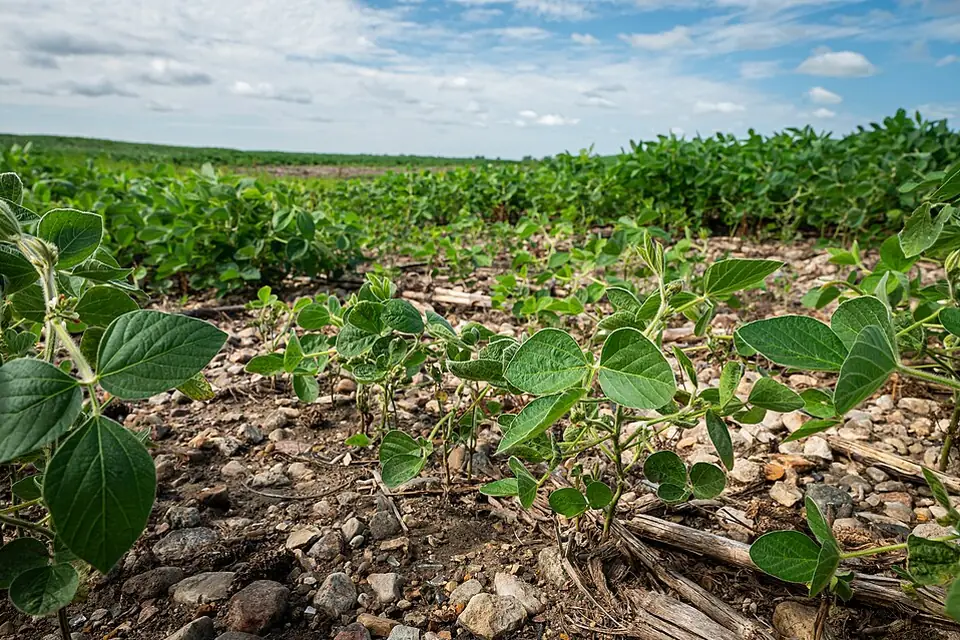
Soybean is India's leading oilseed crop, grown mainly in kharif in Madhya Pradesh, Maharashtra and Rajasthan. As a legume it fixes much of its own nitrogen, so the priority is phosphorus, potassium, sulphur and micronutrients for pod filling and oil content.
What the crop needs most at each growth stage.
Phosphorus, potassium and sulphur as a basal dose; only a small starter dose of nitrogen.
Iron and zinc where deficient; nodules supply most nitrogen.
Boron and potassium for flower and pod retention.
Potassium and sulphur for seed size and oil content.
How to recognise them in the field and how they are usually corrected.
Symptoms
Yellow young leaves with green veins, common in calcareous soils.
Correction
Chelated iron foliar spray.
Symptoms
Uniform yellowing of young leaves; low oil content.
Correction
Sulphur-containing fertilizers in the basal dose.
Symptoms
Yellowing along the edges of older leaves; poor pod filling.
Correction
Potassium in the basal dose.
Exact doses depend on your soil test, variety and irrigation. Tell us your crop stage, area and location and we will recommend the right products and quantities.
Phone
+91 95946 07999